Multi-Agent LLM System for Automated Scientific Literature Review
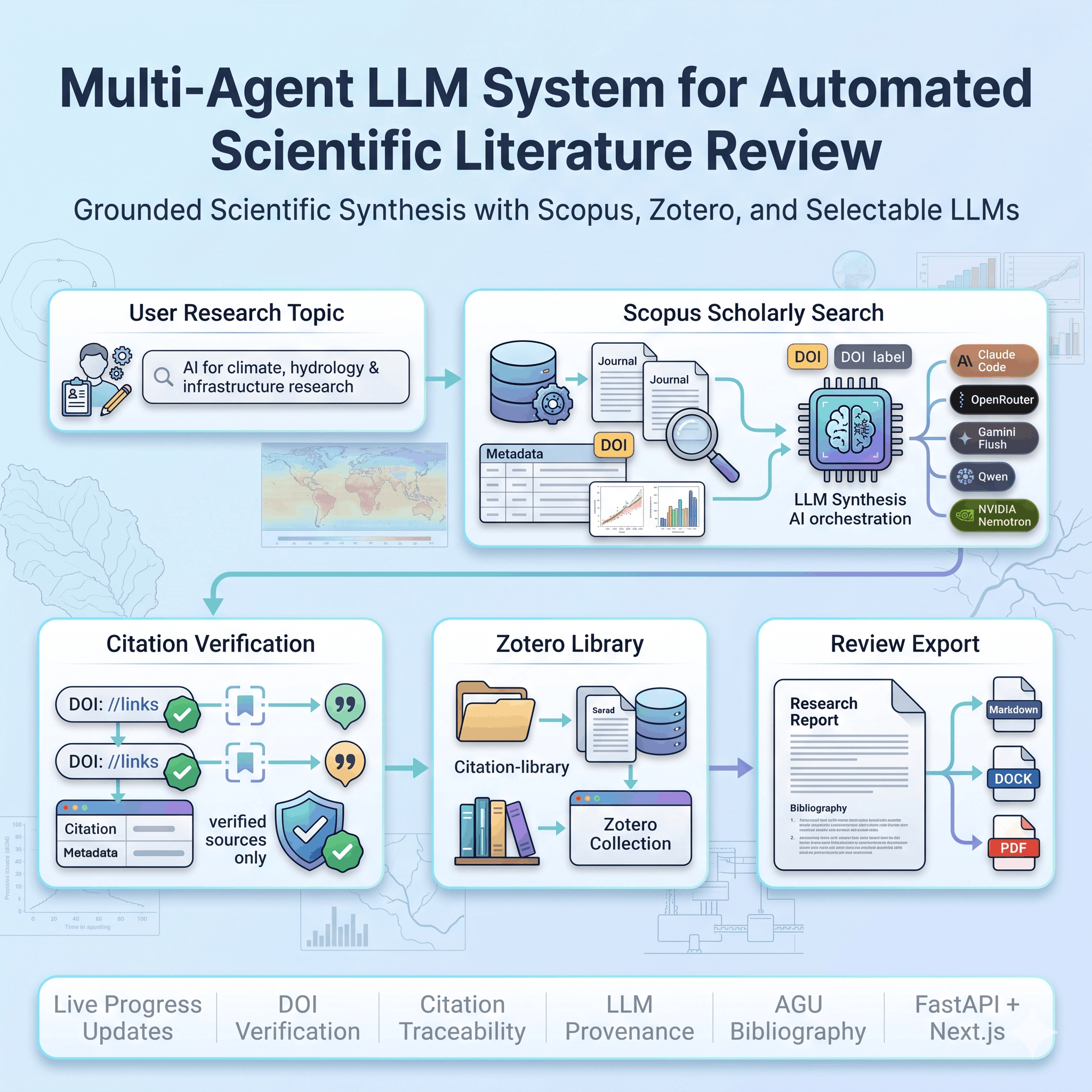
This project is a local research automation application that turns a scientific topic into a citation-grounded literature review workflow. The app combines LLM synthesis with multi-source scholarly and official-document retrieval, LLM relevance classification, DOI/URL verification, Zotero citation management, and document export so generated reviews remain inspectable and tied back to real source metadata.
The system productizes an earlier multi-agent literature-review prototype into a practical FastAPI and Next.js application. Users can choose an LLM backend, select source categories, set search depth, provide a Zotero collection, watch live progress, and download the final review as Markdown, Word, or PDF.
Background & Problem Statement
Scientific literature reviews are slow because they require several kinds of careful work: finding relevant papers, screening abstracts and metadata, synthesizing themes across studies, keeping citations grounded, formatting references, and saving papers for follow-up review.
Generic LLM chat workflows can draft prose quickly, but they often lose citation provenance, invent references, or disconnect claims from verifiable scholarly metadata.
Problem Statement: Can a local GenAI research assistant combine LLM synthesis with scholarly APIs and citation management tooling to make literature review generation more repeatable, traceable, and useful for scientific workflows?
Review Setup Interface
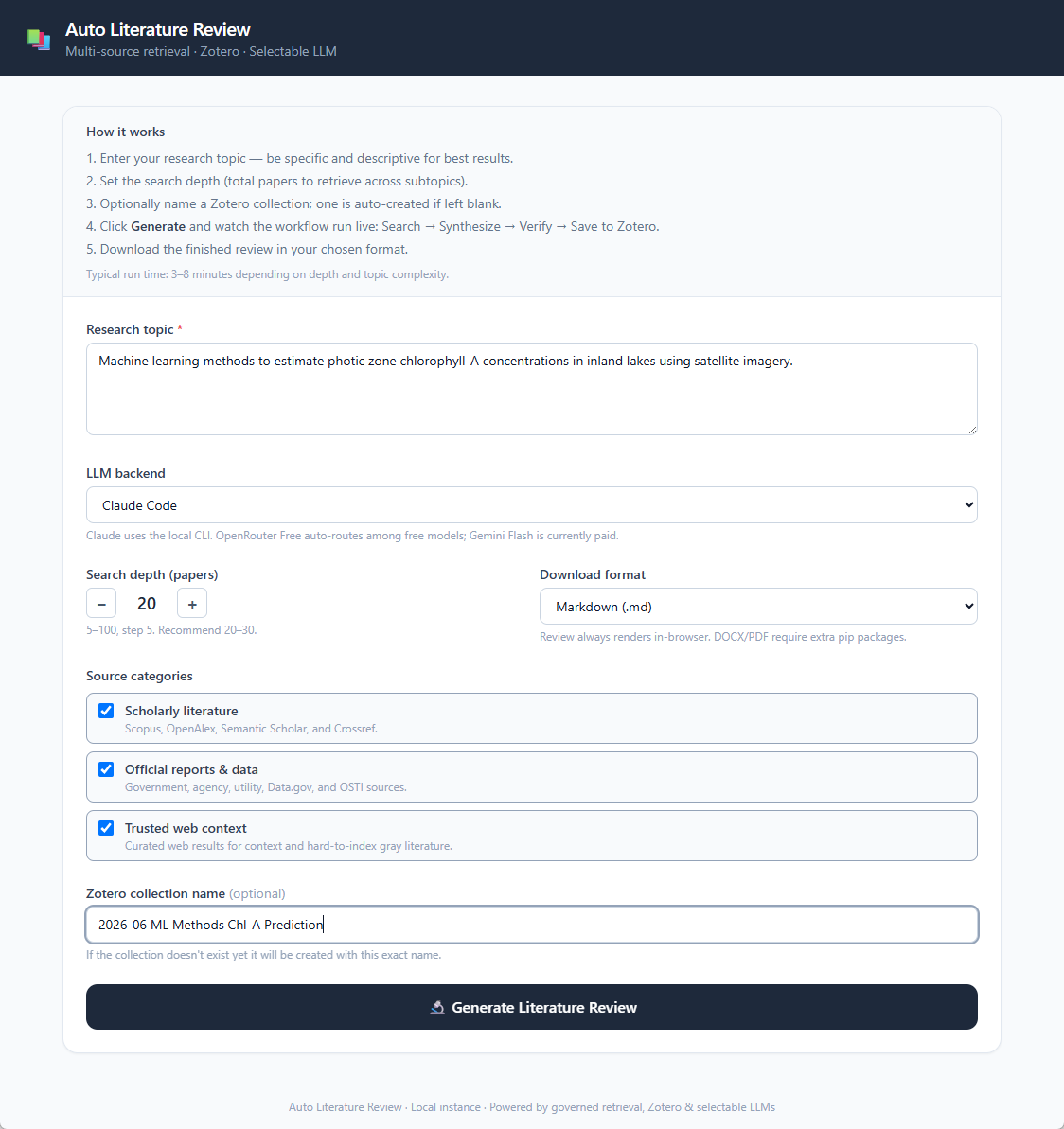
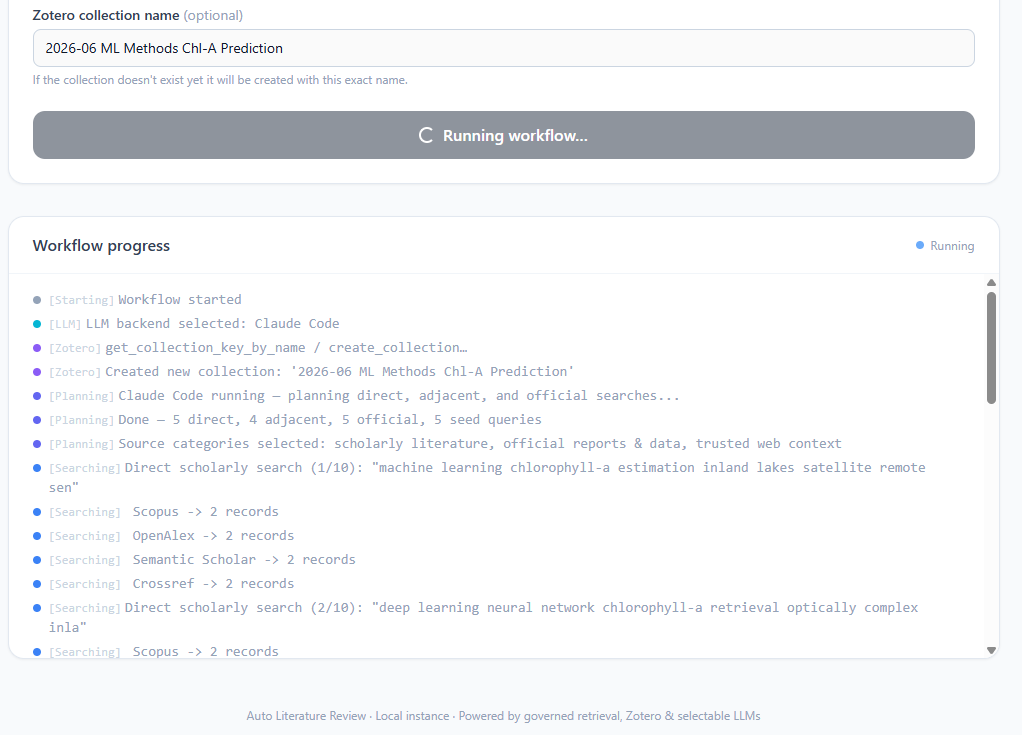
The Next.js interface lets the user enter a research topic, select an LLM backend, choose source categories, set search depth and output format, and optionally provide a Zotero collection name. The frontend consumes server-sent events from the FastAPI backend so the user can follow each step of the workflow while the review is being generated.
System Workflow
The backend orchestrates a multi-step workflow that creates an evidence-aware query plan, searches multiple scholarly and official sources, asks an LLM relevance critic to classify candidate sources, synthesizes a bounded high-priority evidence set, verifies cited DOIs and trusted URLs, saves verified sources to Zotero, and exports the final bibliography in American Geophysical Union style.
- Evidence-aware planning: an LLM converts the user request into direct, adjacent, official-document, and seed-title query families.
- Multi-source retrieval: the app searches Scopus, OpenAlex semantic search via PyAlex, Semantic Scholar, Crossref, SerpAPI trusted domains, Data.gov, and OSTI where selected.
- Evidence governance: an LLM relevance critic labels each deduplicated source as direct, adjacent, or transfer-only relative to the actual topic.
- Bounded synthesis: the synthesis prompt receives a capped high-priority working set that favors direct evidence and avoids oversized timeout-prone prompts.
- Grounded synthesis: the review prompt requires a final
CITED_DOISmarker so the backend can inspect which papers the LLM actually used. - DOI and URL verification: cited DOIs are checked against Scopus with Crossref fallback, while trusted official no-DOI sources are accepted by URL/source tier.
- Citation management: verified papers, reports, and official documents are saved into a selected or auto-created Zotero collection, skipping duplicates already present.
- Document export: the app saves a canonical Markdown review and can generate Word and PDF downloads.
Evidence Governance & Retrieval Quality
A later iteration of the app addressed a key failure mode in automated literature review: retrieval can return plausible but indirect method-transfer papers when the most relevant evidence sits outside a single scholarly index. The revised workflow separates discovery from evidence governance, so the app can distinguish direct evidence from adjacent background and transfer-only analogies.
- Source tiers: sources are tagged as peer-reviewed literature, government or regulator reports, utility/technical documents, professional-society sources, or trusted context-only web material.
- LLM relevance critic: after deduplication, a classification pass labels sources relative to the exact user topic rather than relying on brittle keyword gates.
- Direct-evidence threshold: the final review must disclose when direct evidence is limited instead of padding findings with loosely transferable examples.
- Inspectable rationale: classification reasons are carried into the synthesis context so users can see why a source was treated as direct, adjacent, or excluded.
Selectable LLM Backends
The application is designed for model flexibility. A user can run the same research workflow with Claude Code locally or with OpenRouter-hosted models, including free-router and named backend options. When the OpenRouter free router is selected, the app records both the selected router and the model OpenRouter assigns to the synthesis call.
Supported Model Options
| UI Label | Backend ID | Purpose |
|---|---|---|
| Claude Code | claude |
Uses the local Claude Code CLI for prompt execution |
| OpenRouter Free Router | openrouter_free |
Requests a free long-context model suitable for literature synthesis |
| Gemini 2.5 Flash | gemini_flash |
Routes through OpenRouter to google/gemini-2.5-flash |
| Qwen3 Coder 480B A35B | qwen3_coder_free |
Uses the free Qwen3 Coder OpenRouter model option |
| NVIDIA Nemotron 3 Ultra | nemotron_ultra_free |
Uses NVIDIA Nemotron Ultra through OpenRouter when available |
| NVIDIA Nemotron 3 Super | nemotron_super_free |
Uses NVIDIA Nemotron Super through OpenRouter when available |
Generated Review Outputs
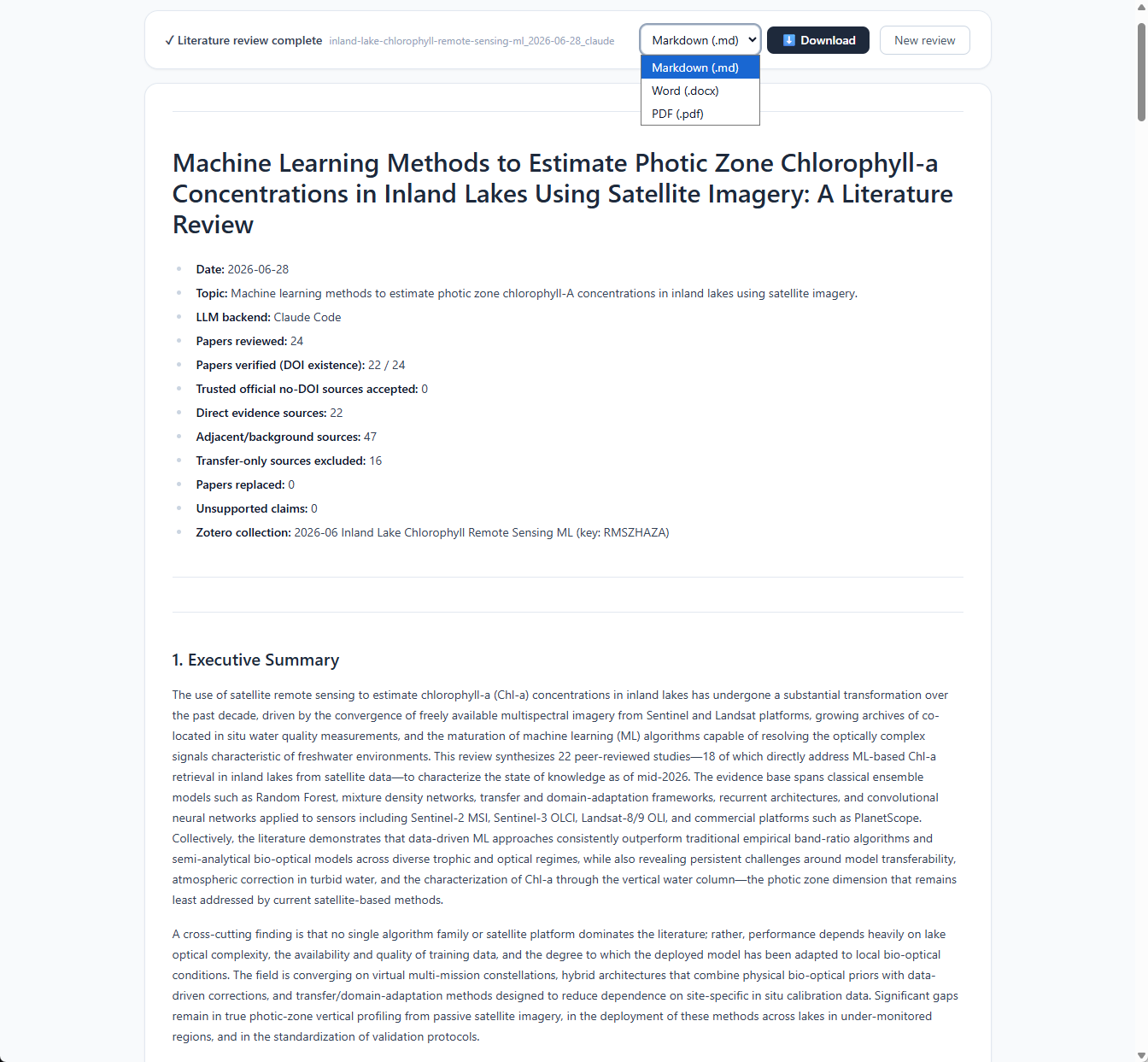
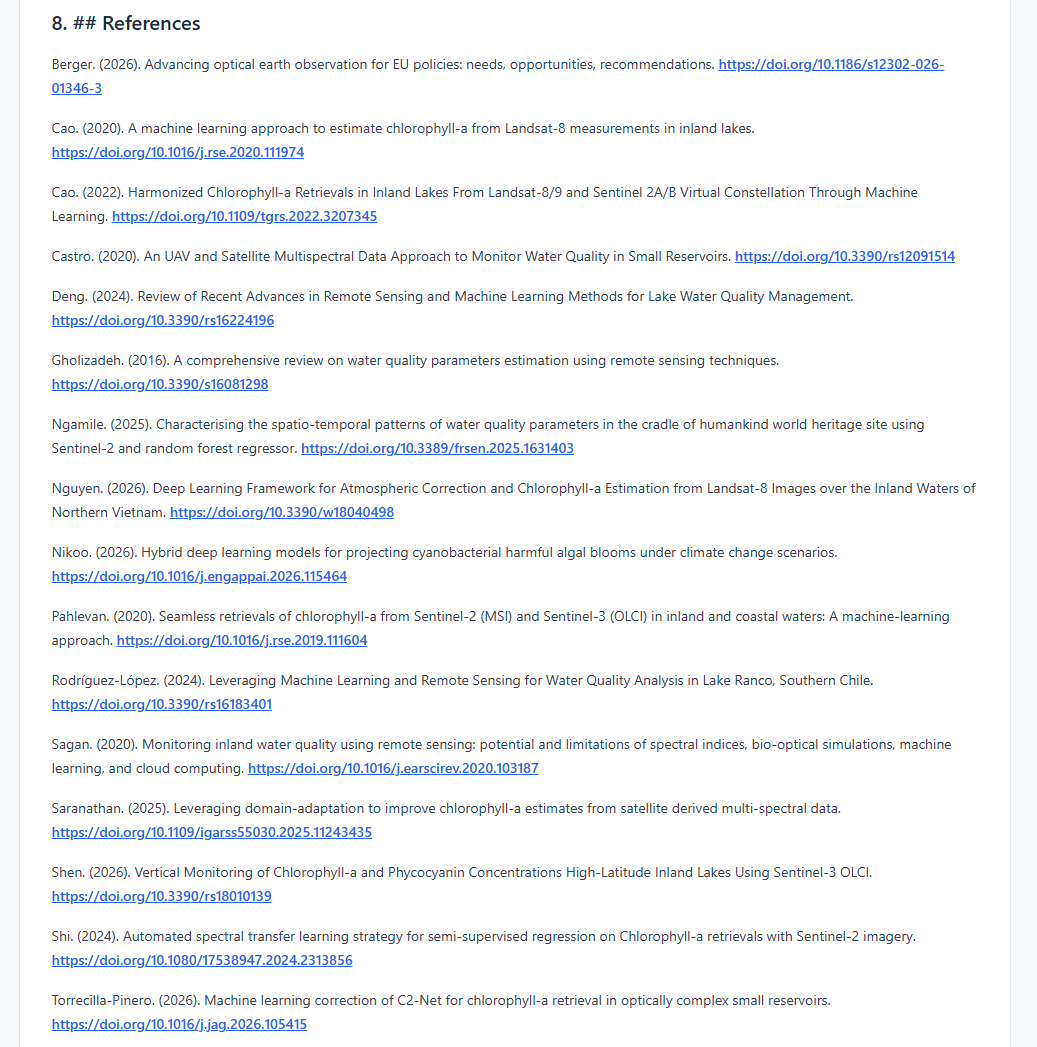
The final report includes run metadata, executive summary, background and scope, thematic synthesis, evidence-governance counts, key sources, research gaps, open questions, and an AGU-style bibliography. Metadata records the topic, selected backend, reviewed sources, direct evidence counts, verified citations, Zotero collection, and assigned OpenRouter model when applicable.
Zotero Integration & Citation Provenance
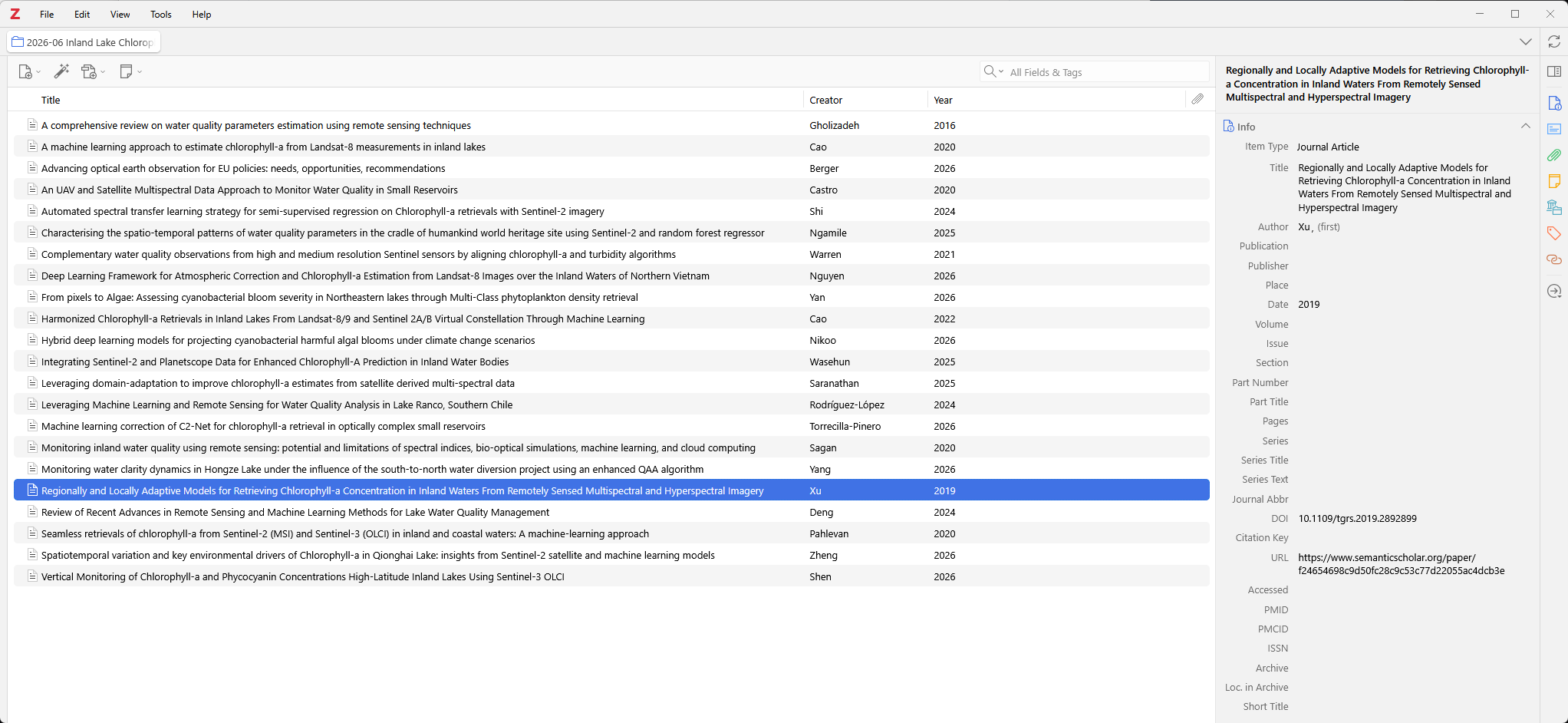
Citation grounding is a core design goal. The backend parses cited DOIs from the LLM output, verifies them through Scopus and Crossref, saves verified papers and selected official documents to Zotero, and uses the Zotero collection as the source for bibliography export. This gives the user both a generated review and a reusable citation-management asset.
- Collection handling: create a new Zotero collection or resume an existing collection by name.
- Duplicate protection: skip DOIs already present in the target collection.
- Bibliography export: produce references in American Geophysical Union style.
- No-DOI support: preserve URL-backed government, utility, and professional documents when they are appropriate evidence for applied topics.
- Run provenance: record verified citation counts, collection keys, LLM backend, and assigned OpenRouter model where relevant.
Applied GenAI Engineering Value
This project demonstrates practical GenAI product engineering for a workflow where traceability matters. Instead of treating LLM output as the final authority, the app wraps generation with API-backed search, LLM relevance screening, DOI/URL checks, citation manager integration, structured exports, and visible run metadata.
- Research automation: converts a high-level topic into a structured, cited review artifact.
- Grounded generation: separates retrieval, relevance classification, prose synthesis, DOI/URL verification, and bibliography export.
- Evidence quality control: uses source tiers and an LLM relevance critic to reduce drift toward loosely related transfer-only literature.
- Model routing: supports multiple LLM backends with provenance tracking for selected and assigned models.
- Full-stack implementation: combines a Next.js frontend, FastAPI backend, async workflow orchestration, document conversion, and external APIs.
- Operational UX: includes live progress updates, clearer API errors, output filenames with topic/date/backend codes, and local development tooling.
GitHub Repository
The implementation is available in the GitHub repository below.
View Project Repository on GitHub
The repository includes the FastAPI app, Next.js frontend, selectable LLM backend workflow, Scopus, OpenAlex, Semantic Scholar, Crossref, SerpAPI, Data.gov, OSTI, and Zotero integrations, document conversion utilities, MCP server code, runtime prompts, development scripts, and documentation for running the app locally.
Disclaimer: this project is for research and portfolio demonstration. Generated reviews should be manually checked before use in academic, regulatory, engineering, or policy decisions.