Teacher Support Studio: Student Proficiency Prediction & AI Teacher Assistant
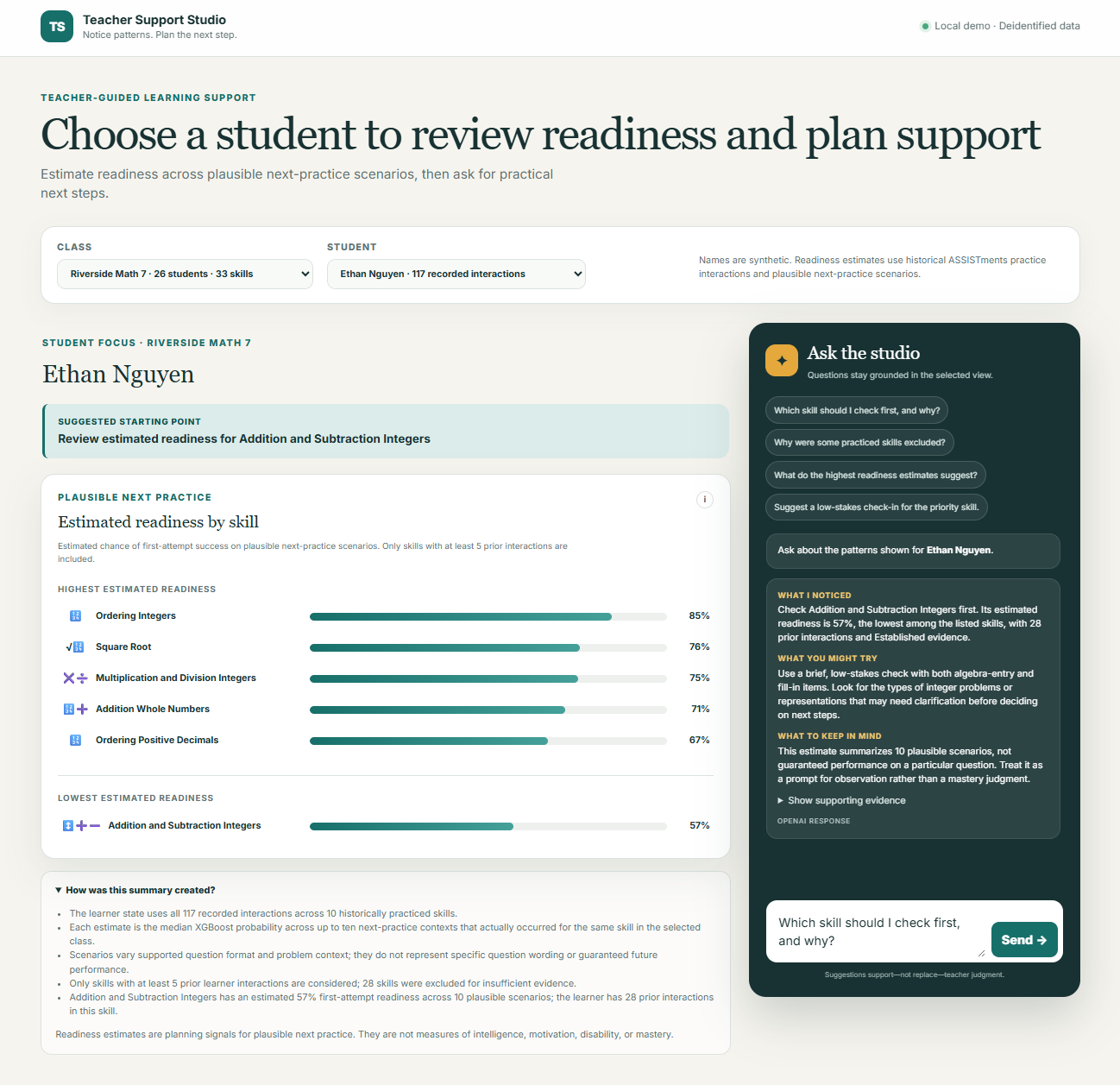
Teacher Support Studio is an end-to-end educational machine learning project that predicts a student's probability of first-attempt success on upcoming skill practice and turns those estimates into teacher-facing, evidence-grounded guidance.
The project combines leakage-safe longitudinal feature engineering, interpretable and nonlinear classification models, model-native SHAP contributions, and a deployable FastAPI application. Its outputs are designed as low-stakes planning signals—not mastery labels or automated instructional decisions.
Background & Problem Statement
Student practice histories contain useful signals about recent performance, prior learning opportunities, help seeking, and skill-specific progress. Used carefully, those signals can help an educator decide where a brief check-in or additional practice may be useful.
Machine Learning Question: What is the probability that a student answers the next skill-practice interaction correctly on the first attempt?
Application Question: How can that probability be presented with its supporting evidence and limitations so teachers retain contextual interpretation and final decision-making?
Dataset & Leakage-Safe Feature Engineering
The modeling workflow uses the ASSISTments 2009–2010 Skill Builder dataset. After filtering to original problems with valid skill identifiers, the working data contains 259,386 interactions from 4,163 students and an overall first-attempt correctness rate of 65.8%.
- 170 documented predictors: student, skill, practice, recency, streak, opportunity, and help-seeking signals.
- Past-only information: longitudinal features are shifted so each row uses only evidence available before the predicted interaction.
- Chronological evaluation: unique interaction order values are split into the earliest 70% for training, the next 15% for validation, and the latest 15% for testing.
- Fair comparison: logistic regression and XGBoost use the same predictor set and held-out evaluation protocol.
- Protected test window: operating thresholds are selected on validation data rather than tuned against final test outcomes.
Modeling Workflow & Evaluation
An L2-regularized logistic regression provides an interpretable baseline, while tuned XGBoost captures nonlinear relationships and interactions in students' learning histories. Both models are evaluated on discrimination, ranking quality, probability error, and threshold-based balance.
Held-Out Test Performance
| Model | ROC-AUC | Average Precision | Log Loss | Brier Score | Balanced Accuracy at Selected Threshold |
|---|---|---|---|---|---|
| Logistic regression | 0.67 | 0.83 | 0.56 | 0.19 | 0.61 at 0.59 |
| XGBoost | 0.70 | 0.85 | 0.54 | 0.18 | 0.63 at 0.64 |
| Prevalence baseline | 0.50 | 0.72 | 0.61 | 0.21 | 0.50 |
- Consistent improvement: XGBoost outperforms logistic regression across discrimination and probability-error metrics.
- Strongest signal: recent student-skill performance—especially mean skill accuracy across the five latest relevant interactions—drives the nonlinear model.
- Interpretability: global feature importance and local SHAP contributions connect predictions to the learner evidence behind them.
- Important limitation: the final test window contains 38,909 interactions but only 87 students, so performance is not evidence of broad unseen-student generalization.
Teacher Support Studio Application
The application lets a teacher select a synthetic class and student, review estimated readiness across named skills, inspect how each summary was created, and ask questions grounded in the evidence currently displayed.
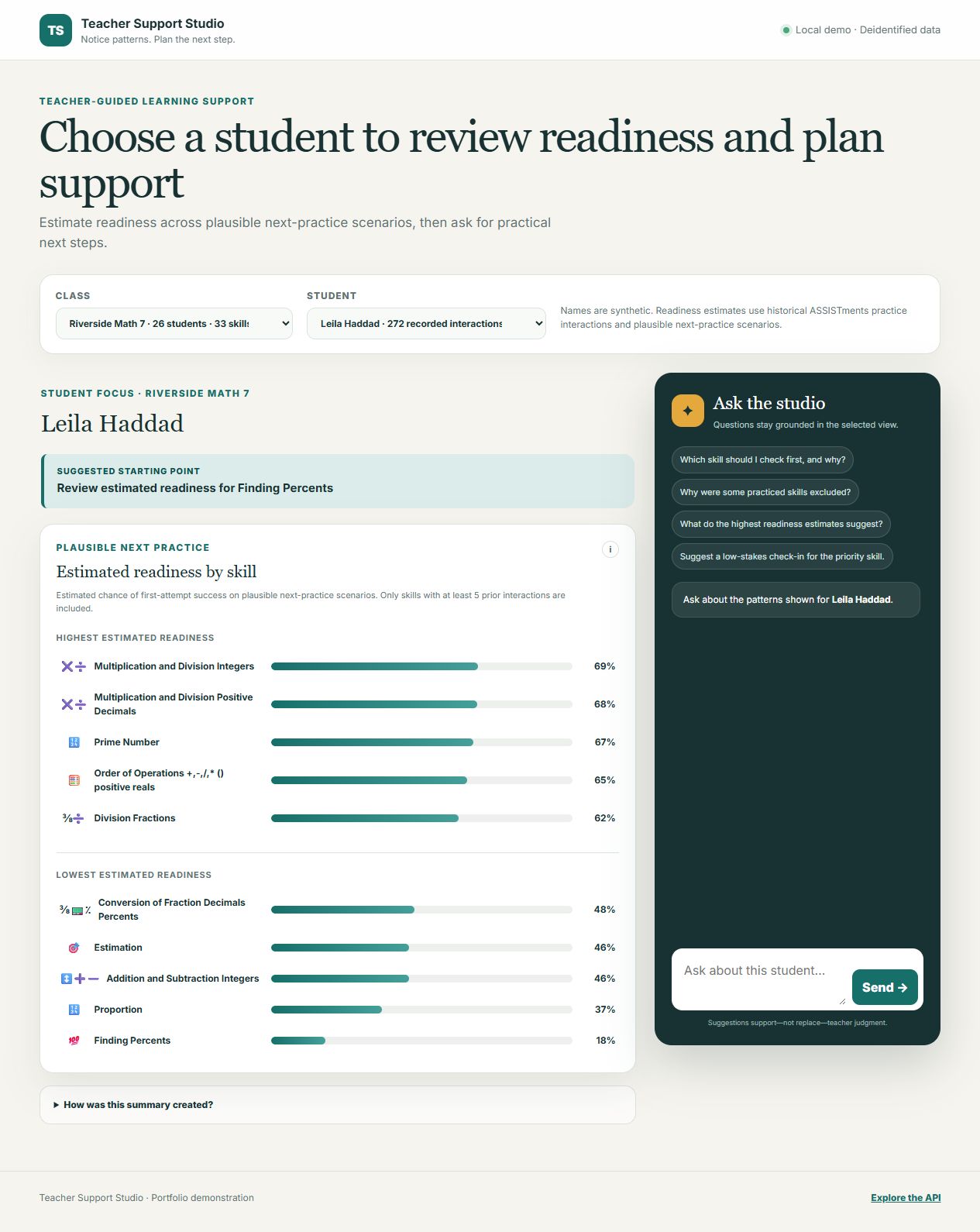
Readiness Scoring Workflow
- The teacher selects a synthetic class and student mapped to authentic deidentified identifiers.
- The application retrieves the student's complete recorded interaction history.
- It constructs up to ten historically observed next-practice contexts for each named skill.
- The persisted XGBoost model scores the scenarios, and their median probability becomes the skill's estimated readiness.
- Skills with fewer than five prior learner interactions are excluded before the five highest and five lowest estimates are selected.
- A LangGraph workflow gives OpenAI only the selected metrics and evidence for a structured response; deterministic local guidance remains available if OpenAI is unavailable.
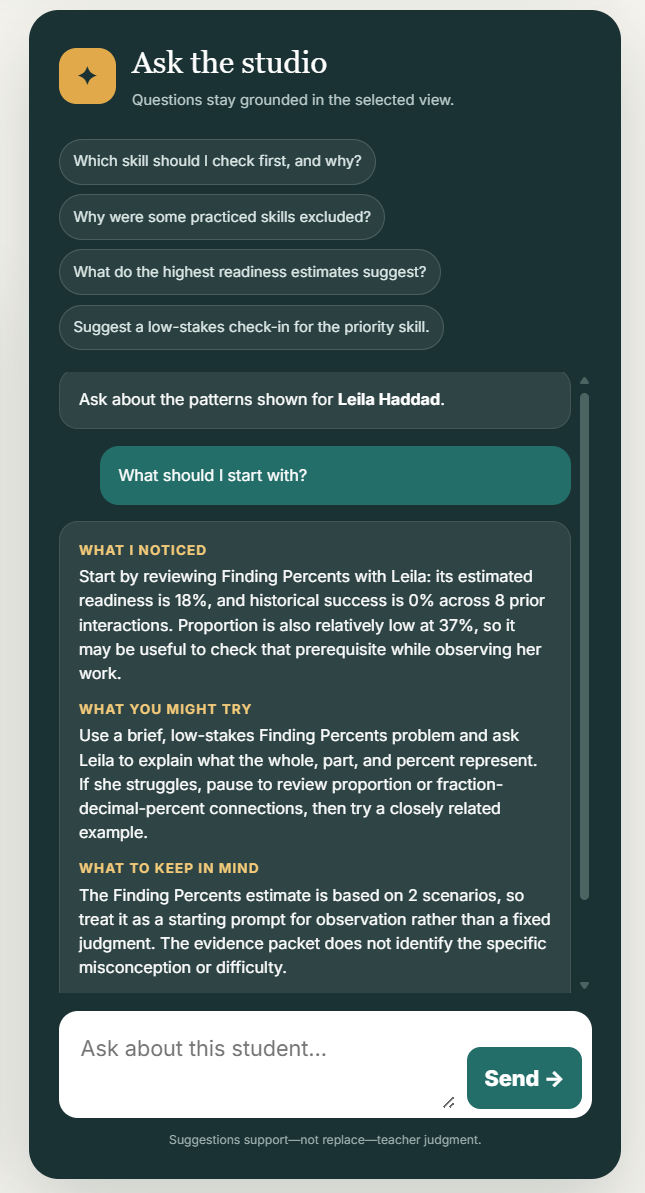
Grounded AI Teacher Assistant
The assistant answers preloaded or free-form questions in three predictable sections: what the model suggests, a low-stakes action the teacher might try, and limitations to keep in mind. The prompt receives only the selected student's displayed metrics and supporting evidence, keeping the response tied to the current view.
Application Architecture & Reproducibility
- Data and modeling: Python, pandas, NumPy, SciPy, scikit-learn, and XGBoost.
- Interpretability: XGBoost model-native SHAP contributions, Plotly, and Kaleido.
- Application layer: FastAPI, Uvicorn, Pydantic, JavaScript, HTML, and CSS.
- Generative AI: LangGraph, LangChain, and OpenAI with a deterministic fallback path.
- Quality and reproducibility: uv, JupyterLab, pytest, Ruff, persisted model artifacts, and ordered notebooks.
- Deployment: a self-contained Render bundle packages the application, model, mappings, and selected demo data.
Responsible Use & Limitations
This project is a portfolio demonstration of teacher-facing decision support. Predictions are planning signals for plausible next practice—not measures of intelligence, general ability, motivation, disability, or psychological mastery.
- Do not use estimates to automatically determine grading, placement, access, or interventions.
- Treat the five-interaction minimum as a demo evidence rule rather than a validated educational standard.
- Interpret results in light of temporal and population shift in the held-out data.
- Validate calibration, subgroup behavior, unseen-student generalization, and instructional impact before real educational use.
- Keep educators responsible for contextual interpretation and final decisions.
GitHub Repository & Live Demo
Explore the complete analysis, application source, reproducible environment, tests, deployment bundle, and interactive teacher-facing demo.
🔗 View Project Repository on GitHub
The live Render service may need a short warm-up after a period of inactivity.