Telco Customer Churn Prediction & Retention Targeting System
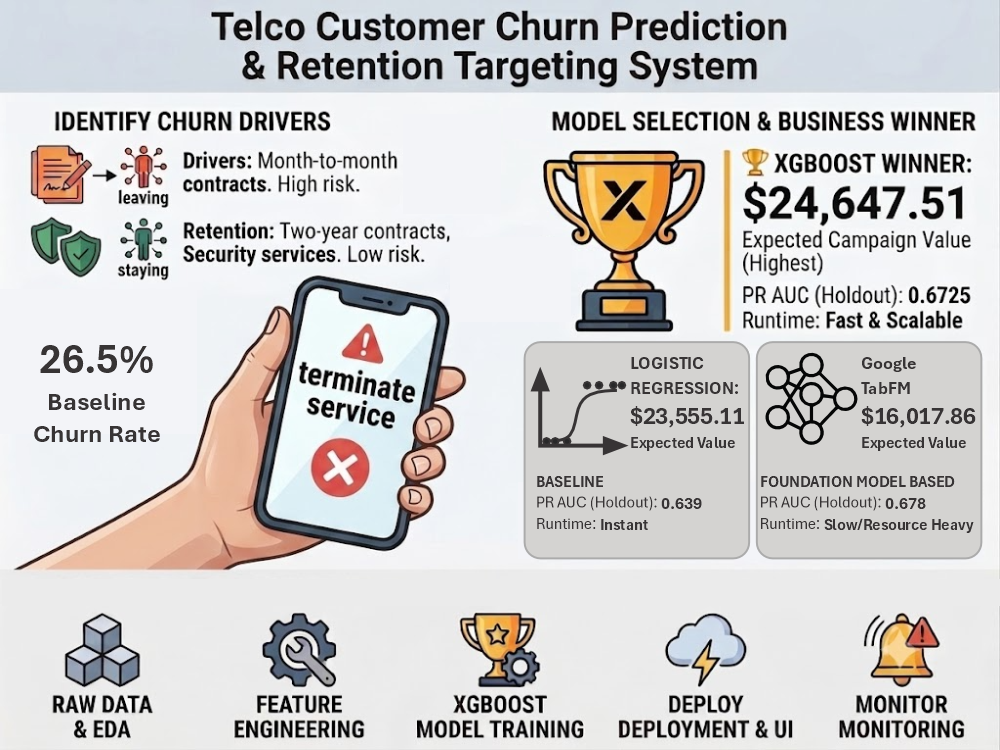
This project builds a production-oriented machine learning workflow for predicting customer churn in a fictional telecommunications business. The system moves beyond a notebook-only classifier by connecting leakage-safe feature engineering, model selection, experiment tracking, API serving, a Streamlit user interface, local monitoring, Docker packaging, and a Hugging Face Spaces deployment.
The business goal is not simply to maximize accuracy. The final workflow ranks customers by expected campaign value, combining churn probability with retained lifetime value and intervention cost assumptions so that retention teams can prioritize outreach where it is most likely to pay off.
Background & Problem Statement
Customer churn reduces recurring revenue and increases customer-acquisition pressure. In a subscription telecom setting, churn risk is shaped by contract terms, tenure, service bundles, billing behavior, support options, and price sensitivity. A useful model needs to identify customers likely to leave early enough for the business to intervene.
Problem Statement: Given customer demographics, subscribed services, account tenure, contract details, and billing history, can a reproducible ML system predict quarterly churn and translate those probabilities into a ranked retention-campaign list?
Dataset & Leakage Controls
The raw source is the IBM Telco Customer Churn dataset, which contains 7,043 customer records and 33 variables covering demographics, geography, service subscriptions, contract and billing information, tenure, churn outcome, and churn explanation fields.
The preferred modeling target is Churn Value, where 1 indicates churn and 0 indicates retention. The pipeline excludes direct identifiers, direct target equivalents, raw coordinates, and post-outcome churn explanation fields from model features.
- Leakage exclusions: CustomerID, Count, Lat Long, Latitude, Longitude, Churn Label, Churn Value, Churn Score, Churn Reason, Churn Category, and similar churn-derived fields.
- Feature handling: yes/no fields are encoded as 0/1, compact categorical variables are one-hot encoded, and blank Total Charges values are handled safely.
- Model-ready outputs: the workflow creates separate datasets for logistic regression and XGBoost/TabFM comparison so each model family can use an appropriate feature set.
Exploratory Analysis & Feature Review
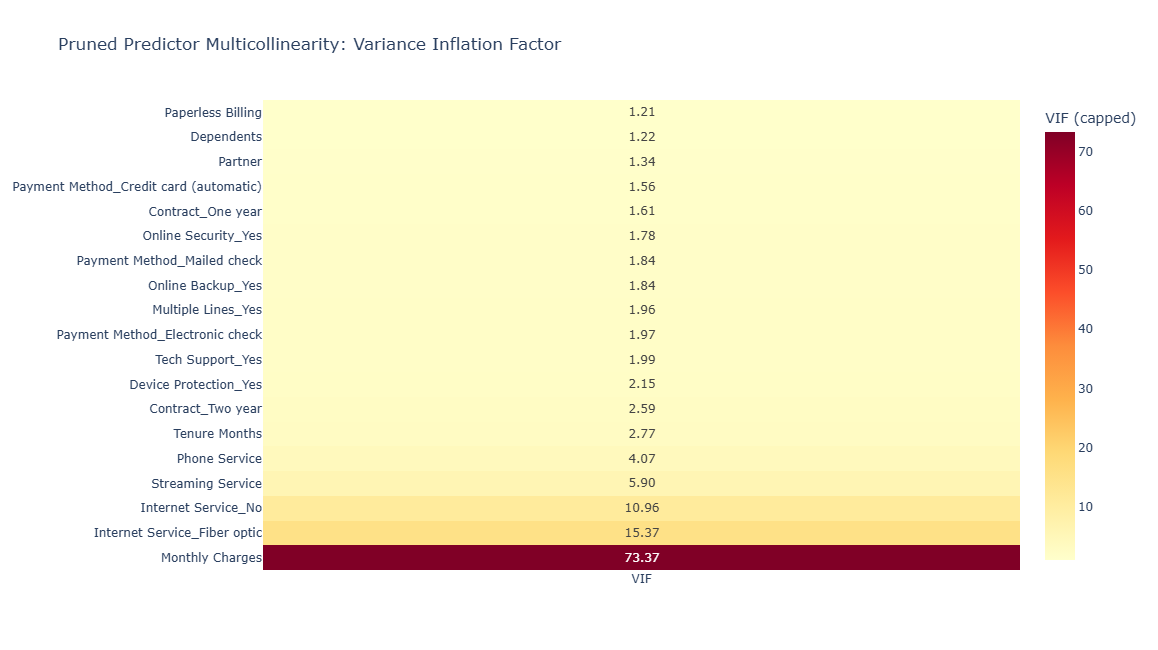
Exploratory analysis focused on understanding which encoded predictors were associated with churn and which predictors carried redundant signal. These checks informed the interpretable baseline while preserving a richer feature set for the nonlinear XGBoost workflow.
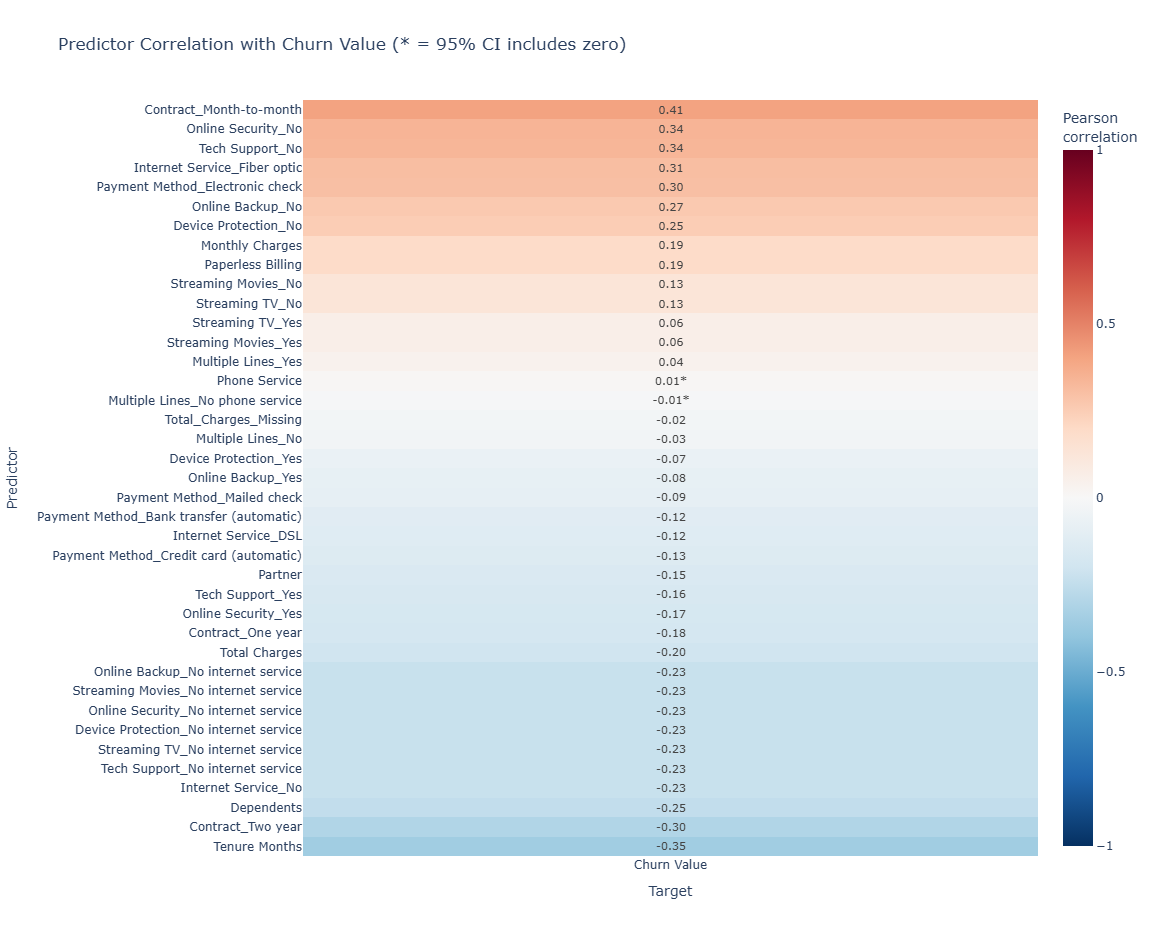
Positive correlations indicate predictors associated with higher churn risk, while negative correlations indicate predictors associated with retention. The multicollinearity review helped prune redundant inputs for the logistic-regression baseline; XGBoost retained a broader encoded feature set because tree-based models are less sensitive to linear multicollinearity.
Modeling Approach
The research notebooks compare logistic regression, Optuna-tuned XGBoost, and a PyTorch/CUDA TabFM benchmark using consistent stratified holdout logic. The packaged production-style workflow focuses on the two practical model families: logistic regression and XGBoost.
- Logistic Regression: a transparent baseline with directly inspectable coefficients and very fast training.
- XGBoost: a tuned gradient-boosted tree model that captures nonlinear interactions and supports SHAP-style interpretation.
- TabFM benchmark: a transformer-based tabular foundation-model experiment retained as historical reference, but not included in the serving and monitoring workflow.
- Thresholding: candidate notebooks default to the training-set churn rate, with validation-based threshold tuning in the reusable package pipeline.
- Experiment evidence: MLflow logs lightweight parameters, metrics, comparison tables, prediction outputs, and retention-targeting summaries.
Model Trade-Offs
| Model | Role | Strength | Best Use |
|---|---|---|---|
| Logistic Regression | Transparent baseline | Fast, auditable, coefficient-based interpretation | Fallback when governance or simplicity matters most |
| XGBoost | Recommended practical model | Strong nonlinear ranking and best top-100 campaign value | Production-style retention targeting workflow |
| TabFM | Foundation-model benchmark | Strong conventional metrics in historical testing | Experimental comparison, not the deployed workflow |
Model Selection & Retention Value
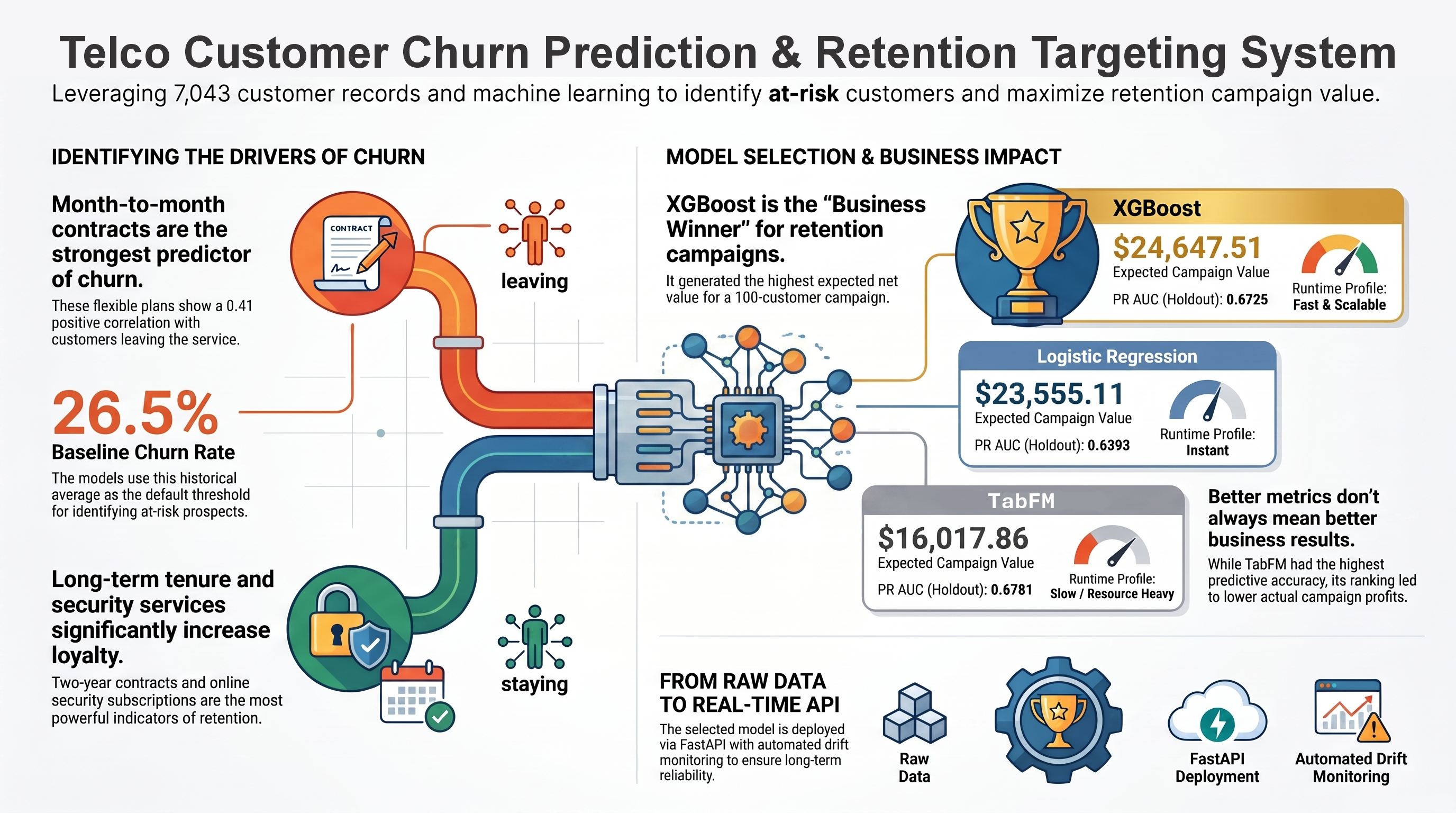
Historical model-selection experiments used five-fold stratified cross-validation on the training split, then evaluated candidates once on the untouched holdout set. TabFM achieved the strongest conventional predictive metrics in that saved run, but XGBoost was selected as the practical recommendation because it delivered the highest expected net value for the top-100 retention campaign list.
Saved Model-Selection Evidence
| Model | Holdout PR AUC | Holdout ROC AUC | Top-100 Expected Net Value |
|---|---|---|---|
| Logistic Regression | 0.6393 | Baseline reference | $23,555.11 |
| XGBoost | 0.6725 | 0.8559 | $24,647.51 |
| TabFM | 0.6781 | 0.8599 | $16,017.86 |
This result illustrates the difference between general ranking quality and campaign value. Retention targeting combines churn probability, retained-LTV assumptions, offer acceptance, retention uplift, outreach cost, and offer cost. XGBoost was nearly tied with TabFM on PR AUC, ran much faster, and produced the stronger value-ranked outreach list under the saved business assumptions.
Production-Oriented MLOps Workflow
The project packages the reusable logic under src/churn_ml/ so training, preprocessing, prediction, serving, monitoring, and UI interaction are not trapped inside notebooks. The production-style pipeline compares logistic regression and XGBoost, selects by validation PR AUC, tunes the threshold, evaluates once on the test split, and persists a local production model bundle.
- Validation and preprocessing: raw schema checks, leakage-safe feature generation, and documented processed outputs.
- Training pipeline: reproducible model comparison, MLflow tracking when available, saved metrics, and persisted model artifacts.
- API serving: FastAPI endpoints for health checks, model information, and churn predictions.
- Monitoring foundation: anonymized JSONL inference logs and local drift checks against a saved training baseline.
- CI/CD readiness: pytest, Ruff linting, import validation, and Docker image build checks through GitHub Actions.
Streamlit Prediction App
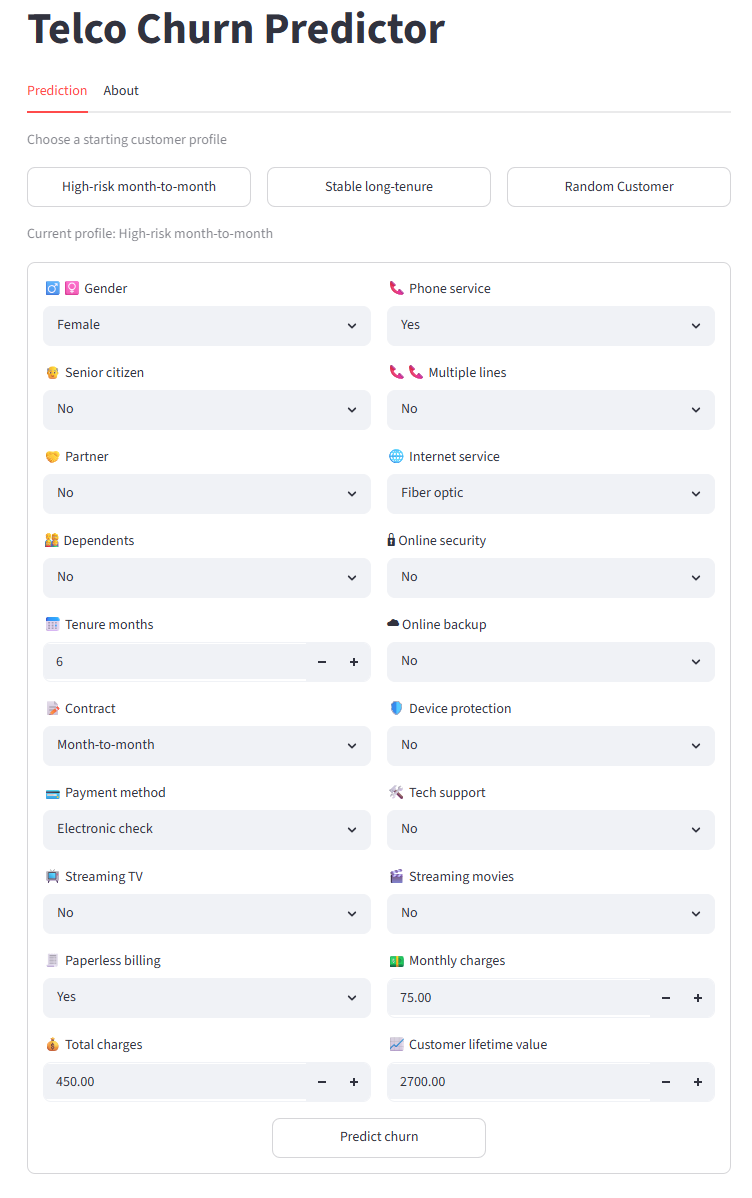
The live application uses a Streamlit front end against a FastAPI prediction endpoint. In the Hugging Face Spaces deployment, the Docker image trains or loads the production model artifact, runs FastAPI internally, and exposes the Streamlit UI on the public Space port.
- Interactive inputs: customer profile, service, contract, billing, and tenure fields are converted into model-ready features.
- Prediction output: the app returns churn probability, classification, and retention-targeting context for the submitted profile.
- Deployment architecture: Docker keeps the hosted demo aligned with the local FastAPI plus Streamlit workflow.
Business & Portfolio Value
The project demonstrates how to connect model quality to a business-facing retention decision. Rather than stopping at classification metrics, it turns churn predictions into a campaign list that can be evaluated against cost, uplift, and customer-value assumptions.
- Actionable targeting: prioritizes customers by expected campaign value, not just raw churn risk.
- Governance awareness: excludes leakage fields and keeps interpretable logistic-regression evidence available alongside the stronger XGBoost candidate.
- Deployment realism: includes API serving, UI interaction, Docker packaging, monitoring foundations, and CI checks.
- Clear trade-off analysis: explains why the production-style workflow uses XGBoost even though TabFM was a useful benchmark.
GitHub Repository & Live Demo
The full implementation is available on GitHub, and the public Hugging Face Space hosts the Streamlit churn prediction interface backed by the production-style FastAPI workflow.
View Project Repository on GitHub
Open Live Demo on Hugging Face Spaces
The implementation includes leakage-safe preprocessing, logistic-regression and XGBoost model comparison, MLflow experiment evidence, FastAPI serving, Streamlit UI interaction, Docker deployment support, drift-check scaffolding, and CI/CD-ready project structure.